


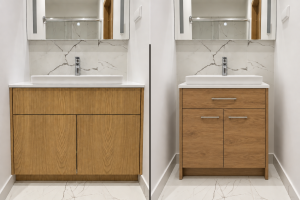
Custom-Made or Store-Bought? When Tailored Furniture Truly Pays Off
Imagine a very everyday situation. You are furnishing a bedroom and looking for a wardrobe. In a store, you find a model at an attractive price, while a wardrobe made according to an individual project costs significantly more.
At first glance, the choice may seem obvious. Why pay more?
However, once you start measuring the room and thinking about everyday use, other questions appear.
Will the wardrobe use the full available wall height? What will happen to the 20 or 30 centimetre gap at the side? Will the shelves and drawers be exactly where they are really needed? Will there be space for suitcases, a vacuum cleaner, shoes and long coats?
And most importantly — will this solution still be convenient after several years?
This is where the comparison itself changes.
The question is no longer only: “Which piece of furniture costs less?”
A much more useful question is: “What am I actually paying for — and is it worth it in my situation?”
That is the question we will try to answer.
When is store-bought furniture truly a good choice?
Let’s start with the most important point — custom-made furniture is not needed in every room.
A ready-made piece of furniture from a store can be a very reasonable and economically justified choice in many situations.
For example, if the room has standard dimensions and the wardrobe or chest of drawers you have found fits almost perfectly, there is no particular reason to look for a more complex solution.
The same applies to situations where you need a piece of furniture that is intended to be used for a few years rather than several decades.
The main advantages of ready-made furniture are usually very practical:
- lower initial price;
- faster purchase and delivery process;
- the product can be viewed already finished;
- many models can be moved to another room or home if needed;
- there is no need to wait for individual design and production.
For example, custom manufacturing is often not necessary for a small bedside table, a freestanding chest of drawers, a coffee table or a chair.
A ready-made solution can also be much more logical in a rental apartment or temporary home.
So the question is not whether store-bought furniture is “worse”. It is much more important to understand whether the specific piece of furniture solves your needs without major compromises.
If the answer is yes, a ready-made product can be a very good choice.
Where do the compromises begin?
The problem usually begins when the room does not match the furniture manufacturer’s standard dimensions.
Let’s say you have a niche that is 2.47 metres wide and ceilings that are 2.70 metres high.
The store offers wardrobes that are 2.00 or 2.40 metres high and available only in a few fixed widths.
Of course, you can buy one of them.
But then you may end up with empty space above the wardrobe, a gap at the side or an unused part of the niche.
In some cases, these are only small visual details. In others, they mean significantly less storage space.
This becomes especially important in smaller homes, where every square metre — and sometimes even every centimetre — matters.
Non-standard niches, sloped ceilings, columns, ventilation shafts, unusual corners and other architectural elements are exactly the places where custom-made furniture most often shows its practical advantage.
It does not have to be “fitted into” the room.
It is designed specifically for that room.
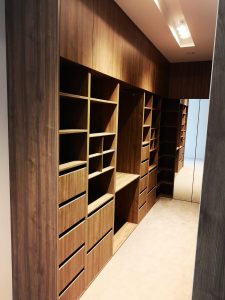
Not only “fits the space”, but adapts to the way we live
Precise dimensions are only one advantage of individually designed furniture.
Functionality is often a much more important question.
Let’s think about the kitchen.
When designing kitchen furniture, it is not only important how many cabinets can be placed along the wall. It is much more important to understand how the specific person will use this kitchen.
Where will pots and pans be stored?
Will the coffee machine stay on the worktop every day?
Where will the waste sorting system be placed?
Are wide and deep drawers needed?
Where will the blender, food processor or other small appliances be stored?
How much space is needed for food supplies?
A person who cooks every day will have very different needs from someone who mainly uses the kitchen for breakfast and coffee.
The same applies to a wardrobe.
One person needs a large space for long garments. Another needs many drawers and shelves for folded clothing. Someone else also needs space for shoes, suitcases, an ironing board and a vacuum cleaner.
This is where one of the main differences becomes clear.
With ready-made furniture, we often adapt our habits to the furniture. A well-designed custom-made piece of furniture can be adapted to our habits.
And this difference is difficult to evaluate by simply comparing two prices in an online store.
Where does the price difference actually go?
One of the most common questions is simple: if a wardrobe in a store costs less, why does a custom-made one cost more?
The answer is not just “better materials”.
In reality, the price difference can be made up of several stages that a ready-made, mass-produced piece of furniture simply does not have.
In the case of an individual project, the price may include measuring the space, designing the solution, choosing materials, selecting fittings, preparing technical drawings, producing parts specifically for the given room, non-standard construction details, delivery and professional installation.
A mass-produced piece of furniture is manufactured in large quantities according to one design.
This allows the manufacturer to optimise costs and offer a lower price.
A custom-made piece of furniture, on the other hand, is essentially a separate project.
That is why comparing only the final price can sometimes be like comparing a ready-made suit from a store with a suit tailored to a specific person. Both can be good, but they are not quite the same product.
At the same time, there is another important aspect to keep in mind.
The term “custom-made furniture” does not automatically guarantee quality.
The result depends on the design process, the materials used, the fittings, the construction, the finishing of details and the quality of installation.
So when comparing offers, it is worth asking not only about the final price, but also about what exactly is included in it.
Materials and fittings — details that become very important in everyday use
A kitchen cabinet hinge, drawer mechanism or lift-up door system may seem like a minor detail at the time of purchase.
After several years of intensive use, it is no longer a minor detail.
In the kitchen, a drawer may be opened dozens of times a day. Cabinet doors — hundreds of times a month.
That is why the quality of the fittings directly affects how the furniture feels in everyday use and how long its mechanisms remain functional.
The same applies to materials.
Different materials vary in durability, moisture resistance, surface maintenance, appearance and, of course, price.
That is why a good individual project does not automatically mean choosing the most expensive material.
It is much more important to choose the most suitable material for the specific place and intensity of use.
Price today or value over time?
It is easy to compare two numbers.
One wardrobe costs 700 euros. The other costs 1,700 euros.
700 is less than 1,700. The maths is simple.
But when choosing furniture, it is often worth adding one more question:
How long and how intensively will we use this piece of furniture?
A kitchen, built-in wardrobe or bathroom furniture are not interior items that we usually replace every year.
We use them every day, often for many years.
In this situation, the initial price is still important, but it is no longer the only criterion.
For example, if an individually designed wardrobe provides 20–30% more practically usable storage space, that can be a meaningful benefit every day.
If properly arranged work zones in the kitchen make cooking more convenient and help avoid unnecessary walking from one end of the room to the other, that is also value.
It is harder to write this on a price tag, but in the long term, these are exactly the things that determine whether we are satisfied with our choice.
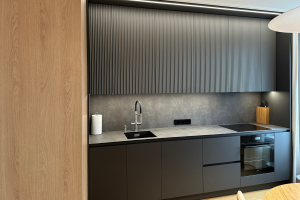
In which furniture categories does a custom-made solution most often pay off?
Not every interior item needs to be made individually.
However, there are several categories where a tailored solution often provides a particularly strong practical benefit.
Custom-made kitchen furniture
In a kitchen, many functions must be combined in a relatively small area.
There needs to be space for dishes, food, appliances, cooking, waste sorting and sometimes also a dining area.
In addition, water and electrical connections, ventilation and appliance dimensions must be taken into account.
That is why the kitchen is one of the rooms where individual design most often delivers a noticeably practical result.
Built-in wardrobes
A built-in wardrobe makes it possible to use the space from wall to wall and, if needed, all the way up to the ceiling.
That is why it is especially useful in bedrooms, dressing areas and hallways.
The upper shelves can be used for seasonal items, suitcases or things used less often, while everyday zones can be created at a comfortable height for the user.
Hallway furniture
The hallway is often one of the smallest rooms in the home, yet it needs to hold a surprisingly large number of things.
Outerwear, shoes, bags, hats, gloves, umbrellas and sometimes also household items.
That is why even 10 or 20 centimetres of unused space can be significant.
Bathroom furniture
In the bathroom, it is necessary to consider not only the dimensions of the room, but also the sink, pipes, wall configuration and moisture.
A standard cabinet may fit visually, but it does not always use the available space most efficiently.
An individual solution allows both the dimensions of the furniture and its internal organisation to be adapted more precisely.
TV walls and living room furniture
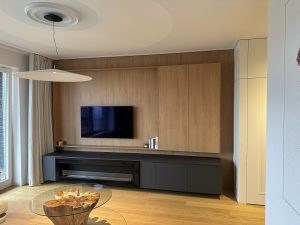
Here, a custom-made solution is especially useful when you want not just a single TV cabinet, but a unified composition for the entire wall.
It can integrate the television, shelves, closed storage areas, lighting or other elements.
The result becomes part of the architecture of the room rather than simply a separate piece of furniture.
When might custom-made furniture not be necessary?
This question is just as important as the question of when to choose custom-made furniture.
If you need a small table, a chair, a freestanding chest of drawers or a simple shelf, there may be many high-quality ready-made solutions on the market.
In a situation where budget is the main criterion, ready-made furniture may also be the smarter choice.
The same applies to rooms that are planned to be redesigned in the near future, or to a home where you do not plan to live long-term.
The greatest value of an individual solution usually appears where the furniture almost becomes part of the room.
The more closely the furniture is connected to the specific space and everyday habits, the more sense it can make to design it individually.
Does custom-made always mean more expensive?
The initial price will usually be higher than for a simple mass-produced piece of furniture.
However, the price range for individually designed furniture can also be very wide.
It is influenced by the size of the furniture, materials, fittings, type of fronts, construction complexity and various design elements.
For example, a simple, functional built-in wardrobe and a complex designer wardrobe with exclusive materials can be two completely different projects.
That is why, when speaking with a furniture manufacturer, it is worth clearly communicating your budget.
A good project is not one where the most expensive possible details are used.
A good project is one where the budget is used in the areas that provide the greatest benefit for that specific person.
5 questions before choosing between store-bought and custom-made furniture
If you are still unsure which path to choose, try answering these five questions honestly.
- Does a standard piece of furniture fit my space precisely?
If standard dimensions work well for the room, custom manufacturing may not be necessary. - Will a ready-made piece allow me to use all the available storage space?
Especially in small rooms, unused 20–30 centimetres can be significant. - Do I have specific functional needs?
For example, space for a specific appliance, long garments, sports equipment or other items. - Do I plan to use this piece of furniture for many years?
The longer the intended period of use, the more important functionality and a well-considered solution become. - Am I willing to compromise on size, materials or design in order to reduce the initial price?
If yes, a ready-made piece of furniture may be completely sufficient.
If the answers to several of these questions point to significant compromises, it is worth at least comparing the price of a ready-made product with an offer for an individually designed solution.
Not because the custom-made option will automatically be better.
But so that you compare two real solutions, not just two numbers.
So — is it worth paying more?
Sometimes, no.
If you find a piece of furniture in a store that matches the room dimensions, your needs, the design and your budget, there is no reason to complicate the process just so you can say the furniture was made to order.
However, there are situations where the lower initial price does not mean the most cost-effective solution.
If the space is non-standard, every centimetre matters, a specific internal layout is needed, or the furniture is intended for intensive use over many years, an individually designed solution can provide much greater practical value.
That is why custom-made furniture and ready-made furniture cannot always be compared fairly based on price alone.
In one case, you are buying an already finished product and adapting your space to it.
In the other, the solution is created for a specific space and a specific person.
The main thing to remember
Custom-made furniture is not necessary in every room.
And it should not be an end in itself.
However, in places where every centimetre matters, everyday functionality is important and the solution is intended for the long term, the lowest initial price does not always mean the best-value choice.
So before making a decision, it is worth asking not only:
“How much does it cost?”
But also:
“What do I receive for this price, how well will it fit my space, and how comfortably will I use it in the coming years?”
If a standard piece of furniture gives a good answer to these questions — excellent.
If not, then it is worth considering an individually designed solution.
Frequently Asked Questions
Is custom-made furniture always more expensive than store-bought furniture?
Individually designed furniture usually costs more than a simple mass-produced solution, because the price may include measuring, design, individual production and installation. However, the final price is significantly influenced by the selected materials, fittings and the complexity of the project.
When does a custom-made built-in wardrobe pay off the most?
Most often, when it is necessary to make maximum use of a niche, the full width of a wall or the height of the room. An individual solution is also especially useful in spaces with sloped ceilings, columns or other non-standard elements.
Is a custom-made kitchen worth it?
If the kitchen is used intensively and planned for many years, individual design can be especially valuable. It allows the placement of cabinets, work zones, appliances and storage solutions to be adapted to specific habits and the space itself.
Does “custom-made” automatically mean higher quality?
No. Quality is determined by the materials used, fittings, construction, manufacturing precision and installation. That is why, when comparing offers, it is important to understand exactly what is included in the price.
How do I know whether I need custom-made furniture?
If a standard piece of furniture leaves a significant amount of unused space, does not meet your storage needs or requires too many compromises, it is worth requesting an offer for an individual solution as well and comparing both options.